
CorePoint Law
Law Offices of Nathan B. Hakimi, Esq.

Civil Litigation • Business Formation • Property Transactions
ABOUT THE ATTORNEY

Nathan B. Hakimi, Esq.
Nathan B. Hakimi, the principal attorney of CorePoint Law LLC, grew up in the Chicagoland area, studied Cognitive Science at Brandeis University and then earned his Law Degree at IIT Chicago-Kent College of Law.He practiced medical malpractice defense for three years at Sax Law and HeplerBroom, defending nurses, hospitals, and doctors in professional negligence lawsuits. Mr. Hakimi then worked in a legal role at JPMorgan corporate banking, facilitating the negotiation and implementation of complex financing contracts.Finally, in 2022, he founded his own practice, initially as "Hakimi Law," now rebranded as: CorePoint Law LLC.Attorney Hakimi is known for his strategic and tactical approach in commercial litigation, business transactions, deal negotiation, dispute resolution, and trial practice. He is respected for his intelligence, fairness, and commitment to achieving success while upholding the integrity of the legal system.Nathan has three children, lives in the West Rogers Park neighborhood of Chicago, where he participates in the Orthodox Jewish community, enjoys playing and listening to music, and studies philosophy and science.He can be contacted at [email protected]
TESTIMONIALS

"Corepoint was excellent to work with ... professionalism, clear communication, and genuine dedication throughout my case. I felt confident and supported from start to finish. Corepoint is a firm I would highly recommend without hesitation." -N.H.
"I had an excellent experience with Corepoint! Highly recommend for anyone seeking reliable and expert legal services!" -A.B.
"It was an absolute pleasure working with Nathan. He ran our case professionally, and we had a wonderful experience." -A.M.
"Nathan was amazing! He was kind knowledgeable and most importantly responsive! He directly answered my questions and was able to help me reach an outcome that ultimately was a win for me." -A.W.
"Fantastic service! Highly recommended." -WoC Inc.
"I have collaborated with Mr. Hakimi on multiple occasions, and I highly regard his professionalism and quality of work." -Atty. J.Y.
"Nathan Hakimi [...] was quick to respond to all of our inquiries, and helped us navigate a daunting legal quagmire. Would recommend him to a friend." -M.K.
"I reached out to Mr. Hakimi and it was the best decision I ever made [...] Having him in my corner allowed me a great level of assurance and confidence and his advice proved to be invaluable." -V.S.
"Nathan Hakimi has been the consummate professional." -M.R.
"I have worked with Nathan on several cases, always a pleasure to collaborate with." -Atty. M.F.
"Nathan was instrumental in advising me and guiding me through the legal process. He explained the relevant laws in a clear and accessible way, which gave me the confidence to assert my rights." -E.S.
"Before contacting Nathan, I contacted 7 different law firms and no one wanted to help with my case. But after I called Nathan, we scheduled a consultation the next day, and my case was resolved in 2 weeks." -D.H.
"Attorney Nathan Hakimi helped make the process a relatively easy and smooth one. Thank you!" -C.H.
PUBLICITY

Press:
Law.com - January 31, 2025'Knowledge of Mismatch:' Federal Judge Offers Guidance on How to Hold Banks Accountable for Erroneous Transfers (Web / PDF)

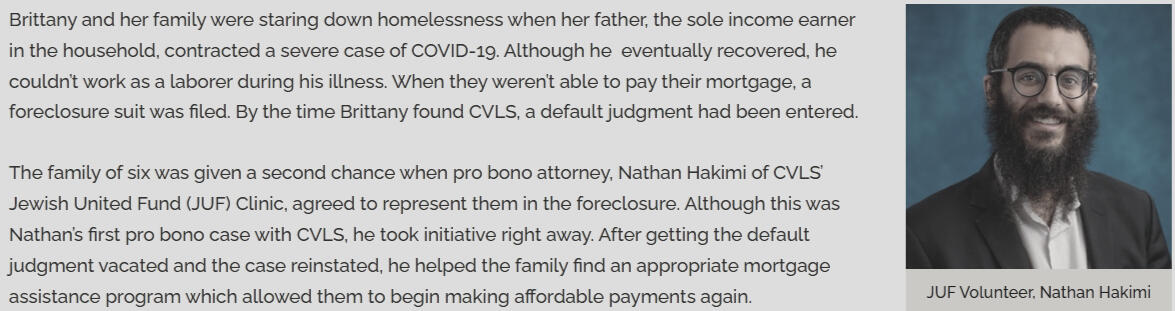
Chicago Volunteer Legal Services - March 26, 2024In First Pro Bono Case with CVLS, JUF Volunteer Saves Family Home (Web / PDF)
Chicago Volunteer Legal Services - May 28, 2024Car Retrieval Made Possible Through Pro Bono (Web / PDF)

Publications:
University of Louisville - Brandeis School of Law, Journal of Animal and Environmental Law (Fall 2017); Monkey Business: Copyright, Stunt Litigation, and New Visions in Animal Law, pp. 1-22. Link PDF
The Decalogue Society of Lawyers, "Tablets" (Fall 2024); "Jewish Court:" What Does it Do?, pp. 16-17. Link PDF
The Decalogue Society of Lawyers, "Tablets" (Fall 2024); "Jews, Lawyers, and Jewish Lawyers," pp. 12-13. Link PDF
The Decalogue Society of Lawyers, "Tablets" (Spring 2025); Judgment on the Pleadings in Light of Jewish Law, pp. 17-18. Link PDF
The Decalogue Society of Lawyers, "Tablets" (Spring 2026); Jurisdiction, Summons, and Default: Beit Din v. State Court, pp. 21-22. Link
IIT Chicago-Kent Journal of Intellectual Property Blog (Nov. 2016); The Status of Software Patents in the Post-Alice Era, Link
IIT Chicago-Kent Journal of Intellectual Property Blog (Mar. 2017); IP Trolls in a Pirates’ World, Link





PRACTICE AREAS

For more information regarding our firm's experience, history, and practice specialties, please visit the Practice Areas page.
PRACTICE AREAS

Commercial & Civil Litigation
Entity Formation & Business Law
Partnership/Contract Breach
Real Property Transactions & Disputes
Professional Malpractice
CorePoint Law handles civil and commercial litigation in a wide variety of areas, such as breach of contract, fiduciary duty, partnership, trusts, and real property.Small businesses utilize CorePoint Law for advisory and transactional services, involving contract drafting, entity formation, employment agreements, and other business services.Additionally, with experience in medical malpractice for defense/insurance prior to starting his firm, Attorney Hakimi handles medical and professional malpractice cases for plaintiffs.
PRACTICE HISTORY

Our firm possesses experience in the following courts, jurisdictions, and dispute resolution forums:Cook County Court Divisions:
• Law Division - Injury Calendar
• Law Division - Commercial Calendar
• Chancery Division
• Municipal Division
• Domestic Relations DivisionIllinois Counties:
• Cook County
• DuPage County
• Kankakee County
• LaSalle County
• McHenry County
• Lake County
• Jefferson County
• Whiteside CountyAppellate Court:
• Illinois Appellate Court, First District
• Illinois Appellate Court, Fourth DistrictFederal Court:
• United States District Court for the Northern District of Illinois
• United States Bankruptcy Court for the Northern District of IllinoisAdministrative Tribunals:
• EEOC (Equal Employment Opportunity Commission)
• IDHR (Illinois Department of Human Rights)
• IDFPR (Illinois Department of Financial and Professional Regulation)Interstate Practice:
• Michigan
• Florida
• Missouri
• New York
• New JerseyAlternative Dispute Resolution:
• Cook County Arbitration Program
• JAMS Mediation, ADR Systems
• Center for Conflict Resolution
REPRESENTATIVE CASES

Fiduciary Breach: Three siblings, who were beneficiaries of a family trust, sued a major national bank as corporate trustee, alleging its failure to maintain the real properties which were held in trust led to losses in their value. After 2+ years of litigating, CorePoint settled for 6-figures.
Noncompete: Two employees left a produce logistics brokerage to start a competitor, and were pursued for violating the terms of their noncompete/nonsolicit. CorePoint refuted many of the accusations and obtained a dismissal of the lawsuit with agreement to release them from the noncompete clause and continue operating.
Malpractice: A 70-year old man sustained near-total vision loss during a neurological infection. CorePoint Law filed suit against the hospital for alleged failure to control intracranial pressure during their treatment of the meningitis, claiming it worsened the damage to the optic nerve, and settled the case for 7-figures.
Cannabis Law: A cannabis licenseholder in Illinois was building a new dispensary, when his conditional permit was revoked by the municipality, leaving a bill of $50,000 with their architect/design firm. CorePoint negotiated a settlement against the value of the cannabis license while its sale was underway to a new operator.
Foreclosure Lien: A family's deceased father held a junior mortgage against his neighbor's property over a personal loan for $60,000. The bank then foreclosed as the senior lienholder. CorePoint succeeded at joining the foreclosure together with the bank to collect against the proceeds of a sale as the junior lienholder.
Landlord-Tenant: A Chicago Police Officer purchased a two-flat and lived in the lower unit. He withheld the security deposit of one of the previous owner's tenants, and the tenant sued over alleged violations of the Chicago Landlord-Tenant Ordinance. CorePoint Law succeeded in arguing that "landlord-occupied" status under the RLTO accrues as of the alleged violation date, not the original lease date, thus precluding statutory damages.
Vehicle Title: CorePoint has represented auto mechanics and dealerships in gaining title over vehicles which are either abandoned in service through a mechanic's lien process, or which require a "bonded title" process with the secretary of state in cases of dealership auction sales with missing title documents.
Condominium/HOA: Multiple cases have been handled by CorePoint Law on behalf of condominium owners, as well as homeowners' associations, involving disputed issues such as HVAC repair, parking space assignments, unit renovation, assessments, levying of fines against owners, and complex sales within associations.
Property Title Disputes: In multiple cases handled by CorePoint Law, a residential property was purchased or owned by one family member, while another member claimed to own all or some portion of it on the basis of various legal or equitable claims. CorePoint has successfully facilitated the disposition of disputed property on behalf of its clients in multiple counties.
Out-of-State Collections: Judgments on cases already tried, where there are assets located in Illinois for collections, have been both defended and prosecuted by CorePoint Law, for amounts ranging from 3-6 figures. This involves bank and payroll garnishments, property liens, and other mechanisms in the miscellaneous remedies courtrooms of Cook County; in addition, CorePoint has participated as counsel in confession of judgment matters.
Contract Drafting and Negotiation: CorePoint Law has reviewed, negotiated, and drafted contracts of various types including new business ventures, employment agreements, leases, asset purchases, partnership and LLC operating agreements, restrictive covenant clauses, and more.
FEE STRUCTURES

Different matters utilize varying fee structures depending on the nature of the legal services and work required. The typical fee structures include: hourly, contingency, flat-fee, and hybrid.For more information regarding the different types of fee structures, please visit "Fees/Payments".To engage in a consultation where we can review your matter and provide a more specific assessment of the appropriate structure that would apply, please submit an inquiry via the "Contact" page.
CONTACT US

Mailing Address:
2807 W. Howard St.
Chicago, Illinois 60645Phone: (312) 210-7700
Fax: (773) 614-4563Email:
[email protected]
Contact us via phone, email, or the inquiry form below to schedule a free consult regarding your matter.
CLIENT RESOURCES
CLIENT PORTAL
• Smokeball Client Portal• Portal App: iPhone | Android

PAYMENTS
PAYMENT LINKS

INSTRUCTIONS
Payments• To make a retainer/deposit payment to your Trust Balance, use the link for: "Trust Deposits."
• To make a payment toward outstanding invoices, use the link for: "Invoice Payments."
• If you have received an invoice via email, it also contains a direct link for payment.
• Card/ACH payments may incur a service charge, equal to the processing fee, up to 3%.
• Deposits and payments may also be sent via Zelle/PayPal to: [email protected].
Client Portal• The Client Portal is hosted by Smokeball, our firm's practice management software.
• Click the link above to "Client Portal," enter the email address used to sign your matter with our firm, and follow the instructions given. The portal is available via browser or mobile app.
• You will be able to view and access features such as: invoices and balances, messages with your attorney, upcoming status and deadlines, and secure document exchange.
FAQ
1) What are the different fee structures used?Different types of cases have different fee structures that are appropriate, which typically include: hourly, contingency, flat-fee, or hybrid.
2) How does the "Trust Account" system work?Payments submitted at the beginning of the case ("retainer"), and periodically as the case progresses ("deposits"), are held in an "IOLTA" ("Interest on Lawyer Trust Account"), which is separately designated for holding client funds. All funds in this account belong to Clients "in trust," and are not the property of our firm, nor are commingled with firm funds, while they remain in the IOLTA Trust Account.As the case progresses, the fees and expenses billed in your case, will be invoiced and deducted from the Trust Account as payments to our firm.Your ongoing invoices will reflect at any given point in time, the amounts that have been billed, and the amount remaining in your Trust Balance. All amounts held in the "IOLTA" Trust Account are fully refundable to the client, upon conclusion of the matter or termination of the representation, at any time.If your matter is on an hourly fee structure, you will deposit an initial retainer, agreed upon when the Matter is initiated, to your Trust Account. The retainer is not a payment itself; the payments are based solely on the hourly fees and expenses incurred, which may be more (or less) than the initial retainer or deposits held in trust.
3) What are "contingency" and "hybrid" fees?A contingency or hybrid-contingency fee may be used for civil litigation plaintiffs, whose recovery in their case itself may become the basis for payment of the representation. Typically, a "one-third" rate is used for contingency billing.In certain cases, it makes sense to use a "hybrid" rate, where a partial hourly-rate and a partial-contingency rate are charged. For example, instead of a $300 hourly rate or a 33.3% contingency, a $150/hour rate plus a 16.67% contingency may be used in hybrid with each other.Every case and every client is different - upon consultation and initiation of your matter we will discuss the possible options that make the most sense before initiating the matter based on a given structure.
4) What about the "flat-fee" structure?Certain types of non-litigation projects with a well-defined scope may be billed on a single negotiated flat-fee basis, inclusive or non-inclusive of costs and expenses.
5) What is the general idea of the fee structures?In legal services, more important than a "fee estimate" is the "fee structure" that matches the type of work being done. These include the Hourly, Contingency, Flat-fee, or Hybrid structures described or any other terms that are determined to be appropriate, including subscription options, payment plans or other considerations. Upon consultation, we discuss the fee structure, estimate timeline and scope, and other terms that are appropriate given your issue.
6) Do you represent both civil Plaintiffs and Defendants?Yes.
7) Do you represent criminal Defendants?No.
8) What is the difference between fees and costs?The fee structures listed above refer to attorney fees themselves. Other expenses such as court fees, process servers, depositions, etc., are called "costs" or "expenses." These are the "parts v. labor" of legal services. They may vary from $100 court filing or service fees, to $1,000+ depositions or witnesses in complex cases requiring experts or discovery. Costs are ultimately the Client's responsibility, but may be paid upfront by the firm and billed from trust, invoiced, or deducted from case recovery as will be negotiated case-by-case upon a consultation.
9) What are expert witnesses, and how does the process work for using them?Lawsuits require expert testimony when an issue of proof involves something only an expert could testify to. This may include malpractice cases, where a qualified peer must testify as to the alleged negligence, business litigation, where the damages calculation requires accounting or appraisal, or other types of special cases. CorePoint Law possesses existing relationships with many types of expert witnesses in various specialties. We will facilitate the selection and preparation of necessary expert testimony as may be appropriate or necessary for your case.
10) Can I make back my attorney's fees?This is a widely-misunderstood issue. In England, the loser of a lawsuit paid the other side's attorney's fees. But the default rule in America is that each party must bear their own fees, unless a specific exception applies (e.g. a contractual provision, or statutory law, containing a "fee-shifting provision"). Consult with our attorneys to determine if this applies to your case.
RETURN TO HOME